L‘électronique automobile refroidit dans des ambiances de 70 à 105 C : pertes des onduleurs et convertisseurs DC-DC, limites des batteries, méthodes de refroidissement. BQUQ (ISO9001, Dongguan) devis sous 12 heures.
Refroidissement de l'électronique automobile : onduleurs, convertisseurs DC-DC et systèmes de batteries
L'électronique automobile refroidit dans un environnement hostile : températures d'air de 70 à 105 °C sous le capot, 60 à 85 °C dans les compartiments électroniques, vibrations sur tous les axes, et étages de puissance qui dissipent 2 à 6 % de leur puissance sous forme de chaleur — un onduleur de traction de 200 kW évacuant plusieurs kilowatts. L'architecture de refroidissement est déterminée par l'emplacement du boîtier et ce qu'il commute : plaques froides liquides pour les onduleurs de traction, air forcé ou boîtiers métalliques passifs pour les convertisseurs plus petits, et contrôle thermique au niveau des cellules pour les batteries.
Une voiture est le pire environnement qu'un circuit imprimé puisse connaître, car la source de chaleur et la victime partagent le même monde métallique scellé et exigu. L'électronique sous le capot cuit près du moteur et de l'échappement ; les chargeurs embarqués et les convertisseurs DC-DC fonctionnent à courant élevé dans des boîtiers scellés ; les blocs-batteries doivent rester au frais pour durer et sous les seuils d'inflammation en cas d'abus. Ce guide cartographie les chiffres pour chaque sous-système afin que l'architecture thermique soit choisie avant la coulée du boîtier.
L'ambiance est l'entrée de conception
Chaque budget thermique automobile commence par la température de l'air autour du boîtier, et ce chiffre varie considérablement selon l'emplacement de montage. Le même convertisseur DC-DC qui survit facilement dans l'habitacle nécessite une conception complètement différente s'il est boulonné sur la transmission. Les spécifications automobiles divisent généralement le monde en zones de montage avec différentes classes d'ambiance, et l'électronique à l'intérieur de chaque zone doit également tolérer la chaleur de ses voisins.
| Zone de montage | Plage d'ambiance typique | Réalité du refroidissement |
|---|---|---|
| Habitacle / coffre | 60–85 °C | Boîtier scellé, puissance modérée : passif possible |
| Compartiment électronique / tablier | 70–95 °C | Conduction vers la carrosserie ou petits ventilateurs |
| Sous le capot, près du moteur | 85–105 °C | Boîtiers métalliques, dissipateurs obligatoires |
| Transmission / adjacent à l'échappement | 105–125 °C+ | Refroidissement liquide ou déclassement requis |
| Air extérieur (capteurs, phares) | 40–60 °C | Dissipateurs passifs souvent suffisants |
Point clé : spécifiez la zone de montage avant de commencer la conception thermique — une exigence d'« ambiance à 105 °C » change la réponse d'un dissipateur en aluminium embouti à une plaque froide liquide. L'écart entre la zone la moins et la plus exigeante est souvent plus grand que la marge thermique totale de l'électronique.
Onduleurs de traction : là où vont les kilowatts
L'onduleur de traction est le plus grand animal thermique de l'électronique du véhicule. Il commute des centaines d'ampères à haute fréquence, et chaque perte par commutation et conduction atterrit dans les modules IGBT ou SiC. Le rendement est élevé — typiquement 96–99 % — mais 1 à 4 % de 200 kW représente 2 à 8 kW de chaleur qui doivent quitter les modules à travers une plaque de base. Cette densité de flux thermique est bien trop élevée pour l'air, c'est pourquoi les onduleurs de traction de série sont refroidis par liquide : modules montés sur une plaque froide ou directement sur le boîtier du canal de liquide de refroidissement, avec de la graisse ou de la brasure comme matériau d'interface thermique (TIM) entre les deux.
| Étage de puissance | Puissance typique | Perte typique à pleine charge | Méthode de refroidissement |
|---|---|---|---|
| Onduleur de traction (IGBT) | 100–300 kW | 2–6 kW (1–4 %) | Plaque froide liquide sur modules |
| Onduleur de traction (SiC) | 100–300 kW | 1–3 kW (rendement supérieur) | Plaque froide liquide, plus petite |
| Chargeur embarqué | 6–22 kW | 100–400 W | Liquide ou air forcé |
| Convertisseur DC-DC (HV→LV) | 1–3 kW | 40–150 W | Air forcé ou dissipateur de boîtier |
| Entraînements auxiliaires (pompes, ventilateurs) | 0,1–2 kW | 5–50 W | Passif ou petit ventilateur |
Point clé : le pourcentage de perte semble faible, mais il est multiplié par une puissance énorme. Un convertisseur efficace à 97 % doit quand même évacuer 3 kW de chaleur dans une ambiance de 85 °C — c'est pourquoi le chemin thermique est conçu en même temps que l'étage de puissance, pas après. La conception thermique côté module est couverte dans notre guide de refroidissement des modules de puissance IGBT.
Refroidissement des convertisseurs DC-DC et chargeurs : air, boîtier ou plaque
Sous l'onduleur, la question thermique devient architecturale : la chaleur peut-elle être dissipée vers le boîtier métallique puis vers l'air, ou le boîtier a-t-il besoin de son propre flux d'air ? Un convertisseur DC-DC de 2 kW perdant 100 W peut souvent être refroidi avec un boîtier en aluminium à ailettes ou un dissipateur interne modeste conduit vers le boîtier — pas de ventilateur, pas de pompe, haute fiabilité. Un chargeur embarqué de 22 kW perdant 400 W nécessite plus : un ventilateur soufflant à travers le boîtier ou une boucle liquide partagée avec le système de refroidissement de la batterie.
| Puissance du dispositif | Plage de pertes (typ.) | Chemin de refroidissement pratique |
|---|---|---|
| < 300 W au total | < 15 W | Passif, cuivre du PCB + petits dissipateurs |
| Convertisseur 1–3 kW | 40–150 W | Boîtier à ailettes, conduction vers le boîtier |
| Chargeur 6–11 kW | 100–250 W | Air forcé à travers un boîtier canalisé |
| Chargeur 22 kW | 300–500 W | Liquide ou air forcé à haut débit |
Point clé : en dessous d'environ 150 W de pertes, un boîtier métallique bien conçu avec des parois à ailettes et une finition noire évacue la chaleur sans pièces mobiles — un véritable gain de fiabilité dans un environnement vibratoire. Au-dessus, le choix entre ventilateur et liquide suit la même logique de densité de puissance que toute électronique, sauf que l'ambiance est de 85 °C et la poussière est celle de la route.
Gestion thermique des batteries : durée de vie et sécurité
Les batteries ont deux problèmes thermiques : la performance et la sécurité. Les cellules au lithium se dégradent plus vite à la chaleur — un fonctionnement soutenu au-dessus d'environ 40–45 °C raccourcit la durée de vie, et une charge en dessous d'environ 0 °C endommage les cellules — le système thermique doit donc à la fois chauffer et refroidir. La sécurité est la contrainte la plus difficile : les chimies NMC courantes peuvent entrer en emballement exothermique à des températures internes supérieures à environ 150 °C, et une fois l'emballement déclenché dans une cellule, le bloc doit empêcher sa propagation. Le rôle du refroidissement est de maintenir les cellules dans la plage de fonctionnement en vie normale et d'évacuer la chaleur plus vite que les voisines ne peuvent être enflammées en cas d'abus.
| État de la batterie | Température cible (typ.) | Conséquence |
|---|---|---|
| Plage de fonctionnement (Li-ion, typ.) | 15–35 °C optimal | Meilleure durée de vie et puissance |
| Soutenu au-dessus d'environ 45 °C | Dégradation de la durée de vie | La perte de capacité s'accélère |
| Charge en dessous d'environ 0 °C | Dommages / placage de lithium | Limiter le courant de charge ou chauffer d'abord |
| Cellule interne au-dessus d'environ 150 °C | Risque d'emballement (NMC, typ.) | Contrôle de la propagation thermique nécessaire |
Point clé : le refroidissement du bloc est un problème de répartition et d'évacuation de la chaleur à l'échelle du module — plaques froides liquides sous les modules, répartiteurs de chaleur en aluminium entre les cellules, et barrières à changement de phase ou isolantes entre les cellules pour arrêter la propagation. L'aluminium structurel qui porte le bloc fait partie du chemin thermique, c'est pourquoi les pièces en aluminium usinées et embouties dans les blocs-batteries sont spécifiées à la fois pour la résistance et la conduction.
Vibrations, étanchéité et pièces métalliques qui font les deux travaux
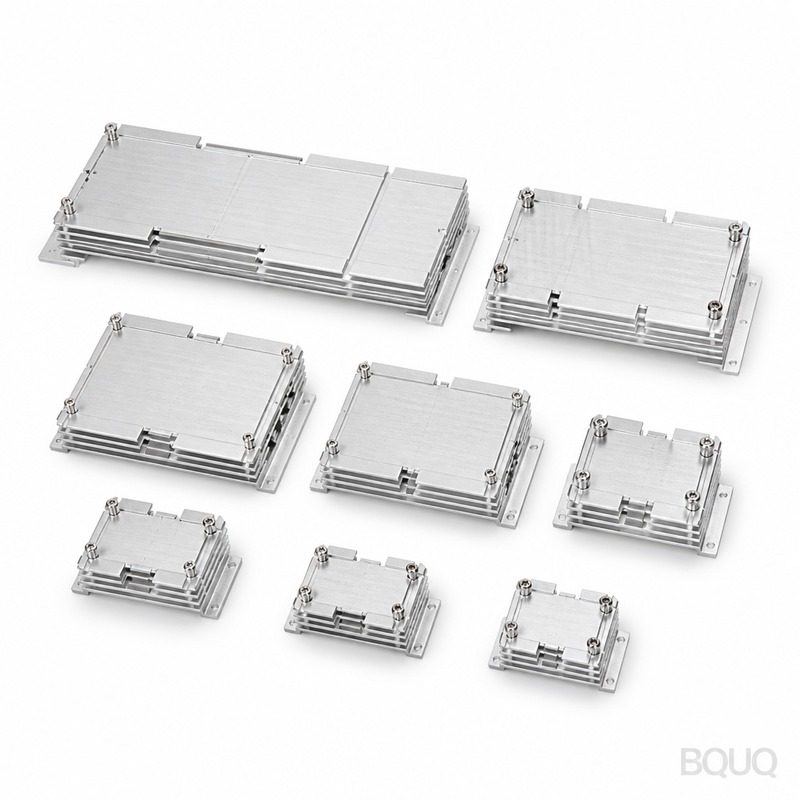
L'électronique automobile doit survivre aux vibrations qui desserrent les fixations, aux chocs qui fissurent les joints de soudure, et à l'eau et au sel qui corrodent le métal exposé. La solution thermique doit vivre dans ce monde : les dissipateurs sont boulonnés ou clipsés contre les vibrations plutôt que collés, les TIM sont choisis pour résister au pompage, et les boîtiers à ailettes servent également d'éléments structurels. Le revêtement conforme protège les cartes, mais il isole aussi — gardez-le hors des interfaces thermiques. Les boîtiers scellés (lavage IP6K9K, par exemple) poussent la chaleur à travers les parois, ce qui favorise les boîtiers en aluminium anodisé noir avec une généreuse surface d'ailettes, et les répartiteurs de chaleur ou ailettes en tôle emboutie lorsque le volume justifie l'outillage.
Chez BQUQ, les pièces thermiques automobiles que nous voyons suivent un schéma : dissipateurs thermiques usinés CNC extrudés, et dissipateurs thermiques emboutis spécifiés avec la même rigueur de dessin que toute pièce de sécurité — certificats de matériaux, planéité sur la face du module, et rapports d'inspection par lot. Le contrôle de processus ISO9001 couvre la documentation, et la capacité d'usinage de ±0,005 mm sur les faces de montage critiques est disponible là où l'alignement du module l'exige. Envoyez la spécification thermique et le dessin à sc@bquq.com pour un devis sous 12 heures ouvrables ; la comparaison air vs refroidissement liquide aide à cadrer quelle architecture votre budget de pertes nécessite réellement.
Questions fréquemment posées
Q : Quelle température peut-il faire sous le capot d'une voiture pour l'électronique ?
R : La température de l'air près du moteur et de l'échappement est typiquement de 85 à 105 °C, avec des points adjacents à la transmission ou à l'échappement plus élevés. Combinée à la chaleur propre de l'électronique, l'ambiance effective pour la conception thermique dépasse souvent 100 °C, ce qui impose des boîtiers métalliques ou un refroidissement liquide.
Q : Pourquoi les onduleurs de traction des VE sont-ils refroidis par liquide ?
R : Un onduleur commutant 200 kW perd 2 à 6 kW même avec un rendement de 97 à 99 %, concentrés sur de petites plaques de base de modules IGBT ou SiC. Ce flux thermique dépasse de loin ce que l'air peut évacuer dans l'espace disponible, c'est pourquoi les modules sont montés sur des plaques froides liquides ou directement sur des boîtiers à canaux de liquide de refroidissement.
Q : Quelle température est nocive pour un bloc-batterie lithium-ion ?
R : Un fonctionnement soutenu au-dessus d'environ 40–45 °C accélère la perte de capacité, et une charge en dessous d'environ 0 °C risque le placage de lithium. Des températures internes supérieures à environ 150 °C peuvent déclencher un emballement exothermique dans les chimies NMC courantes, donc le refroidissement du bloc doit couvrir à la fois la durée de vie et le contrôle de la propagation.
Q : Les convertisseurs DC-DC automobiles peuvent-ils être refroidis passivement ?
R : Oui, lorsque les pertes restent modérées — environ jusqu'à 100–150 W pour un convertisseur dans un boîtier en aluminium à ailettes bien conçu. Le boîtier conduit la chaleur vers les parois à ailettes et la rayonne ; au-delà, l'air forcé ou une boucle liquide devient nécessaire dans l'ambiance chaude sous le capot.
Q : Qu'est-ce qui différencie la conception de dissipateurs thermiques automobiles de celle de l'électronique grand public ?
R : L'ambiance (jusqu'à 105 °C+), les vibrations (intégrité des fixations et des TIM), l'étanchéité (IP6K9K), et les cycles thermiques sur une plage de −40 à +125 °C. Les pièces sont spécifiées avec des certificats de matériaux, une planéité contrôlée et une inspection par lot — la même rigueur que pour tout composant lié à la sécurité.
Articles connexes
- igbt-power-module-cooling-guide — Plus de la série d'ingénierie de gestion thermique BQUQ.
- air-cooling-vs-liquid-cooling-electronics — Plus de la série d'ingénierie de gestion thermique BQUQ.
- heat-sink-mounting-methods-guide — Plus de la série d'ingénierie de gestion thermique BQUQ.
Ressources connexes
- À propos de BQUQ : une usine source certifiée ISO9001 à Dongguan exploitant quatre lignes de production sous un même toit.
- Dissipateurs thermiques et pièces thermiques : options extrudées, usinées CNC et embouties de la ligne thermique — dissipateurs thermiques extrudés, dissipateurs thermiques usinés CNC, dissipateurs thermiques emboutis.
- Tendances de l'industrie : analyses de fabrication, de marché des matériaux et d'approvisionnement pour les acheteurs.
- Articles techniques : guides d'ingénierie et comparaisons de processus — plus d'articles comme celui-ci.
- Centre FAQ : réponses rapides sur le CNC, l'emboutissage, les ressorts et les dissipateurs thermiques.
- Études de cas : pièces réelles et chiffres réels de projets que nous avons conçus et livrés.
- Contactez-nous : envoyez votre dessin et obtenez un devis sous 12 heures ouvrables.
Rédigé par l'équipe d'ingénierie BQUQ. BQUQ est une usine source certifiée ISO9001 à Dongguan, en Chine, exploitant des lignes d'usinage CNC, d'emboutissage des métaux, de ressorts sur mesure, de dissipateurs thermiques et de pinces sous un même toit. Envoyez les dessins à sc@bquq.com ou WhatsApp +86 13713157787 pour un devis sous 12 heures ouvrables. www.bquq.com