Comment les dissipateurs thermiques sont testés : placement des thermocouples, souffleries, ce que promettent les valeurs de résistance des fiches techniques. BQUQ (ISO9001, Dongguan) devis sous 12 h.
Comment les dissipateurs thermiques sont testés : thermocouples, souffleries et fiches techniques
La performance d'un dissipateur thermique se mesure, elle ne se suppose pas : une puissance connue est injectée dans un bloc chauffant ou un composant réel monté sur le dissipateur, les températures sont relevées avec des thermocouples à des points définis, et la résistance thermique est la différence de température divisée par la puissance. Le chiffre n'est aussi fiable que le test — la fixation des thermocouples, la mesure du flux d'air et le contrôle de la température ambiante déterminent si la valeur de la fiche technique survit au contact avec votre produit.
Chaque fiche technique de dissipateur thermique comporte une courbe de résistance thermique, et chacune de ces courbes provient d'un test réalisé par quelqu'un. L'écart entre ce test et votre application est là où naissent la plupart des surprises thermiques : le fournisseur a testé avec une source de chaleur en cuivre boulonnée sur une base parfaitement plane dans un air non obstrué, alors que votre produit a une petite puce, un clip embouti et un boîtier encombré. Ce guide explique comment les tests se déroulent réellement afin que vous puissiez lire une fiche technique — ou effectuer une vérification vous-même — sans vous laisser tromper.
La mesure de base : puissance en entrée, température en sortie
La résistance thermique du boîtier à l'ambiant est définie comme (Tboîtier − Tambiant) / P. Le test nécessite donc trois éléments contrôlés : une puissance dissipée connue, une lecture de température correcte au niveau du boîtier, et un environnement stable et connu. La puissance provient généralement d'un élément chauffant — une résistance, une puce de test thermique, ou le composant réel alimenté à un courant défini. Le dissipateur est monté exactement comme en production, l'ensemble est laissé à atteindre l'équilibre (souvent 30 à 60 minutes), et les températures sont enregistrées.
| Élément de test | Son rôle | Notes pratiques |
|---|---|---|
| Résistance chauffante / puce de test | Fournit une puissance connue | Étalonner la courbe résistance-température |
| Composant réel | Teste l'interface réelle | La puissance varie avec la température — la mesurer en direct |
| Alimentation + multimètre | Règle et enregistre la puissance | Enregistrer P à l'équilibre, pas à la mise sous tension |
| Enregistreur de thermocouples | Enregistre les températures | Enregistrer jusqu'à ce que la dérive soit < ~0,1–0,2 K sur plusieurs minutes |
| Contrôle de l'ambiant | Fixe la condition de test | Les tests en air calme nécessitent une enceinte ou une chambre sans courant d'air |
Point clé : l'équilibre est le mot que la plupart des tests de laboratoire contournent. Un dissipateur retiré d'un essai de 10 minutes rapporte une résistance plus faible que le même dissipateur à 60 minutes car l'aluminium est encore en train de chauffer et le delta-T semble flatteur. Enregistrez la tendance et attendez la stabilisation.
Placement des thermocouples : d'où vient l'erreur
Un thermocouple mesure la température de sa propre jonction, et cette jonction est facilement trompée. Collé à la surface d'une base de dissipateur, un thermocouple lit autant le ruban adhésif et l'air environnant que le métal en dessous. La hiérarchie acceptée : les jonctions percées-et-fixées ou soudées lisent la vérité ; les jonctions collées à l'époxy lisent approximativement ; les jonctions collées avec du ruban lisent plusieurs degrés en dessous ; et une jonction laissée libre sous un composant lit ce qu'elle veut.
| Méthode de fixation | Erreur typique | Utilisation |
|---|---|---|
| Soudée ou brasée dans un trou percé | Classe ±0,5 K | Température de boîtier de référence |
| Fixée dans un trou percé avec de l'époxy | ±1–2 K | Vérification en production |
| Collée à plat sur la surface avec de l'époxy | ±2–5 K | Contrôles rapides uniquement |
| Ruban Kapton ou aluminium | ±3–8 K (lit en dessous) | Jamais pour les décisions de conformité |
| Libre sous le composant | Imprévisible | Jamais |
Point clé : lors d'un test de vérification, la différence entre des thermocouples soudés et collés peut dépasser la marge totale que vous avez conçue. Percez un trou de 1 à 1,5 mm dans la base ou la patte de montage du composant, fixez la jonction à l'intérieur, et lisez le chiffre qui est réellement vrai. Le guide des méthodes de montage des dissipateurs thermiques montre où se situent ces points de mesure sur des assemblages réels.
Souffleries et flux d'air : le test en air forcé
Les valeurs en air forcé nécessitent un flux d'air contrôlé, et « contrôlé » fait un vrai travail dans cette phrase. Une installation correcte est une soufflerie en boucle ouverte ou fermée avec un redresseur d'écoulement pour que l'air atteignant le dissipateur soit uniforme, plus un moyen de mesurer la vitesse — une sonde anémométrique dans le conduit ou une chute de pression calibrée à travers une buse. Le résultat est une courbe de résistance thermique en fonction de la vitesse frontale ou du débit volumétrique, généralement rapportée en LFM (pieds linéaires par minute) ou en m³/h.
| Terme de flux d'air | Valeur typique | Pourquoi c'est important |
|---|---|---|
| Vitesse frontale | 1–5 m/s (200–1000 LFM) | C'est par rapport à cela que la courbe de la fiche technique est tracée |
| Débit volumétrique | Valeur du ventilateur en m³/h ou CFM | Ce n'est pas la même chose que la vitesse au niveau des ailettes |
| Chute de pression | Pa à travers le dissipateur | Les ventilateurs faibles calent sur les réseaux d'ailettes denses |
| Air libre vs canalisé | Choix du fournisseur | Les tests sans carénage flattent le dissipateur |
Point clé : faites correspondre la condition de test à votre produit. Si le dissipateur est placé derrière un ventilateur soufflant en espace ouvert, la courbe en air libre s'applique ; s'il est dans un canal canalisé, les données de chute de pression du fournisseur importent plus que la courbe de vitesse. La valeur de débit en air libre d'un ventilateur n'a aucun sens une fois que le dissipateur lui résiste — le point de fonctionnement est là où la courbe du ventilateur et la courbe de pression du dissipateur se croisent.
Ce que promettent réellement les chiffres des fiches techniques
Une résistance publiée de, disons, 1,2 K/W à 300 LFM signifie : dans ces conditions de flux d'air spécifiques, avec cette taille de source de chaleur et ce montage spécifiques, le fournisseur a mesuré 1,2 K/W. Changez une variable et le chiffre bouge. Les variables les plus abusées sont la taille de la source (un gros bloc de cuivre répartit la chaleur dans la base bien mieux qu'une petite puce) et la température ambiante (un test à « 25 °C » avec la chaleur perdue du banc d'essai à proximité n'est pas à 25 °C au niveau du dissipateur).
| Condition de la fiche technique | Différence réelle typique | Effet sur la résistance |
|---|---|---|
| Gros bloc de test en cuivre | Petite puce réelle | +10–30 % (perte d'étalement) |
| Base plane nue, graisse fraîche | Clips, pads ou joints secs | +20–100 % |
| Flux d'air sur banc ouvert | Obstruction du boîtier | +10–25 % |
| Ambiant de laboratoire à 25 °C | Ambiant interne de 45–60 °C | Même K/W, températures absolues plus élevées |
| Réseau d'ailettes neuf | Poussière, recirculation | Augmente progressivement au fil du temps |
Point clé : considérez la résistance de la fiche technique comme le meilleur cas, puis ajoutez les écarts que votre produit impose réellement. Le tableau de déclassement dans notre article sur le calcul de dimensionnement des dissipateurs thermiques quantifie chacun d'eux — taille de la source, orientation, altitude, obstruction — afin que le chiffre de la fiche technique devienne un point de départ plutôt qu'une promesse.
Réaliser votre propre vérification — et ce que l'usine devrait envoyer
Vous n'avez pas besoin d'une soufflerie pour vérifier un dissipateur passif : une résistance de puissance, un thermocouple fixé dans la base et une boîte sans courant d'air suffisent pour vérifier la résistance en convection naturelle à quelques pour cent près. Pour les conceptions en air forcé, reproduisez le ventilateur et le conduit du produit plutôt que d'emprunter une soufflerie de laboratoire. Quelle que soit la voie choisie, les critères de réussite doivent être écrits avant le test : température maximale du boîtier à la puissance nominale après équilibre à l'ambiante la plus défavorable, avec le matériau d'interface de production.
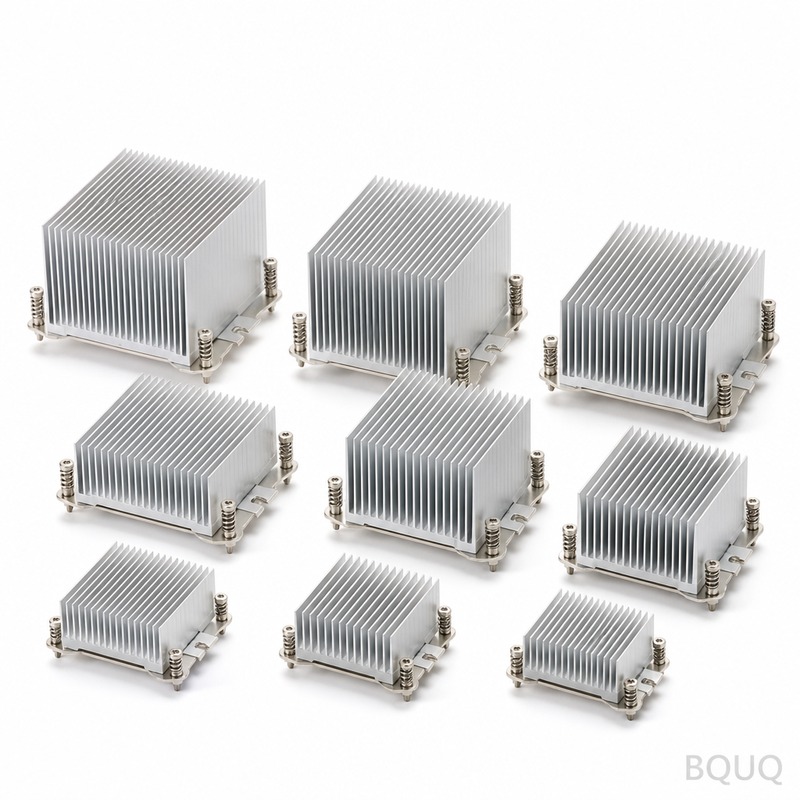
Lorsque le dissipateur est sur mesure, demandez à l'usine le rapport de test — le rapport d'inspection dimensionnelle est standard, et un test thermique sur l'échantillon réel boucle la boucle entre le dessin et la physique. Chez BQUQ, les dissipateurs usinés et extrudés sont expédiés avec la documentation de lot ISO9001 habituelle, et les lignes de dissipateurs thermiques usinés CNC et de dissipateurs thermiques extrudés établiront un devis à partir de votre spécification thermique sous 12 heures ouvrables — incluez votre méthode de test dans la demande et l'échantillon pourra être validé dans les mêmes conditions que celles que votre produit rencontrera.
Questions fréquemment posées
Q : Comment la résistance thermique d'un dissipateur est-elle mesurée ?
R : Une puissance connue est dissipée à travers un élément chauffant ou un dispositif réel monté sur le dissipateur ; les températures au niveau du boîtier et dans l'ambiant sont enregistrées jusqu'à l'équilibre ; la résistance est égale à la différence de température divisée par la puissance. Le flux d'air, s'il y en a, est mesuré et rapporté avec le résultat.
Q : Quelle est la précision des valeurs de résistance thermique des fiches techniques de dissipateurs ?
R : Précises pour la condition exacte testée — généralement une grande source de chaleur en cuivre sur une base plane dans un flux d'air ouvert. Les produits réels ajoutent 10 à 30 % ou plus en raison de sources plus petites, de variations d'interface et d'obstruction du boîtier. Traitez donc le chiffre de la fiche technique comme un meilleur cas et déclassez-le.
Q : Où dois-je monter un thermocouple pour mesurer la température du boîtier ?
R : Dans un petit trou percé (1–1,5 mm) dans la patte du composant ou la base du dissipateur, avec la jonction fixée ou collée à l'époxy en place. Les thermocouples collés en surface lisent plusieurs degrés en dessous et peuvent faire échouer une bonne conception ou en valider une mauvaise.
Q : Quelle est la différence entre LFM et CFM dans les spécifications des dissipateurs ?
R : LFM est la vitesse de l'air au niveau des ailettes (pieds linéaires par minute) ; CFM est le débit volumétrique déplacé par le ventilateur. Un ventilateur à haut CFM peut encore fournir une faible vitesse aux ailettes si le flux est bloqué ou contourne le dissipateur, c'est pourquoi la résistance est tracée en fonction de la vitesse, et non de la valeur du ventilateur.
Q : Combien de temps doit durer un test thermique de dissipateur ?
R : Jusqu'à ce que la tendance de température se stabilise — généralement 30 à 60 minutes pour les dissipateurs métalliques et plus longtemps pour les grands assemblages passifs. Les tests courts renvoient des chiffres flatteurs car le dissipateur est encore en train de chauffer vers l'équilibre.
Articles connexes
- heat-sink-sizing-calculation — Plus d'articles de la série technique sur la gestion thermique de BQUQ.
- heat-sink-selection-workflow — Plus d'articles de la série technique sur la gestion thermique de BQUQ.
- heat-sink-mounting-methods-guide — Plus d'articles de la série technique sur la gestion thermique de BQUQ.
Ressources connexes
- À propos de BQUQ : une usine source certifiée ISO9001 à Dongguan exploitant quatre lignes de production sous un même toit.
- Dissipateurs thermiques et pièces thermiques : options extrudées, usinées CNC et embouties de la ligne thermique — dissipateurs thermiques extrudés, dissipateurs thermiques usinés CNC, dissipateurs thermiques emboutis.
- Tendances de l'industrie : analyses de fabrication, de marché des matériaux et d'approvisionnement pour les acheteurs.
- Articles techniques : guides d'ingénierie et comparaisons de procédés — plus d'articles comme celui-ci.
- Centre FAQ : réponses rapides sur l'usinage CNC, l'emboutissage, les ressorts et les dissipateurs thermiques.
- Études de cas : pièces réelles et chiffres réels de projets que nous avons conçus et livrés.
- Contactez-nous : envoyez votre dessin et recevez un devis sous 12 heures ouvrables.
Rédigé par l'équipe d'ingénierie de BQUQ. BQUQ est une usine source certifiée ISO9001 à Dongguan, en Chine, exploitant des lignes d'usinage CNC, d'emboutissage des métaux, de ressorts sur mesure, de dissipateurs thermiques et de pinces sous un même toit. Envoyez vos dessins à sc@bquq.com ou WhatsApp +86 13713157787 pour un devis sous 12 heures ouvrables. www.bquq.com