Équilibrage des mandrins à pince à grande vitesse : classes ISO 1940-1 G6.3, G2.5 et G1, et équilibrage du porte-outil assemblé. BQUQ usine des mandrins à pince.
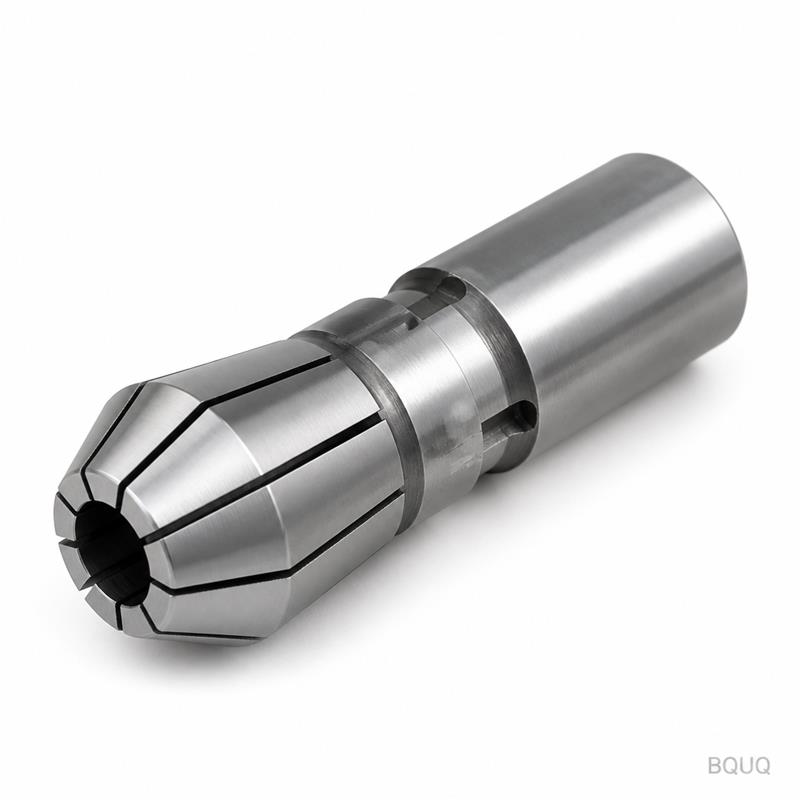
Équilibrage des mandrins à pince pour l'usinage à grande vitesse : G2.5 et au-delà
Un mandrin à pince qui tourne rond à 8 000 tr/min peut secouer une machine à 20 000 tr/min, car la force de balourd croît avec le carré de la vitesse. Les classes d'équilibrage telles que G2.5, définies par la norme ISO 1940-1, indiquent le balourd résiduel admissible pour votre vitesse maximale — et la seule façon fiable de les respecter à grande vitesse est d'équilibrer le porte-outil assemblé : corps du mandrin, pince et écrou ensemble.
La concentricité et l'équilibrage sont des qualités différentes. Un porte-outil peut être parfaitement concentrique — chaque surface parfaitement alignée sur l'axe — et vibrer quand même, car la masse autour de l'axe n'est pas répartie uniformément. Les fentes de la pince, les méplats d'entraînement de l'écrou, les trous de vis de fixation : tout cela est asymétrie. À basse vitesse, vous ne le remarquez jamais. Au-delà d'environ 10 000 tr/min, vous le ressentez sur l'état de surface, la durée de vie de l'outil et, finalement, les roulements de broche. Ce guide explique les classes, la physique et le processus d'équilibrage.
Pourquoi le balourd devient dangereux à grande vitesse
Un corps rotatif déséquilibré produit une force rotative égale à la masse de balourd multipliée par son rayon et par le carré de la vitesse angulaire : F = m × r × ω². Doubler la vitesse quadruple la force. C'est pourquoi le même porte-outil, parfaitement acceptable à 8 000 tr/min, vibre violemment à 24 000 tr/min — trois fois la vitesse, neuf fois la force de balourd.
Un exemple concret rend cela réel. Prenons un balourd résiduel de 1 g·mm — un très petit nombre, environ un gramme de matière à un millimètre de l'axe. À 10 000 tr/min, cela génère environ 1 N de force rotative ; à 30 000 tr/min, le même 1 g·mm produit environ 10 N, oscillant à 500 Hz. Dix newtons de force rotative au niveau du porte-outil, c'est un problème d'état de surface, un problème de durée de vie d'outil et, à terme, un problème de broche.
| Vitesse (tr/min) | Force due à un balourd de 1 g·mm (approx.) | Ce que vous remarquez |
|---|---|---|
| 5 000 | ~0,3 N | Peu de choses |
| 10 000 | ~1 N | Marques sur les outils longs |
| 20 000 | ~4 N | Broutage, usure accélérée de l'outil |
| 30 000 | ~10 N | Vibrations de la broche, risque de dommages aux roulements |
Valeurs approximatives — la force exacte dépend du rayon et de la vitesse ensemble. La forme de la courbe est la leçon : les problèmes de balourd arrivent soudainement lorsque la vitesse augmente, c'est pourquoi les broches à grande vitesse sont livrées avec des exigences d'équilibrage intégrées.
Les nombres G : ce que signifie réellement G2.5
La norme ISO 1940-1 définit les classes de qualité d'équilibrage par un nombre G suivi de la vitesse maximale admissible du centre de masse du rotor en millimètres par seconde : G6.3, G2.5, G1, G0.4. Plus le nombre G est bas, plus l'équilibrage est strict. Le balourd résiduel admissible dépend de la classe, de la masse du rotor et de la vitesse de fonctionnement. Ainsi, une exigence G2.5 sur un porte-outil lourd à 20 000 tr/min permet un balourd absolu plus important en g·mm qu'une exigence G2.5 sur un porte-outil léger à la même vitesse — la classe est à l'échelle du rotor.
| Classe d'équilibrage | Recommandations d'application typiques | Plage de vitesses typique |
|---|---|---|
| G6.3 | Pièces mécaniques générales, porte-outils conventionnels | Jusqu'à ~10 000 tr/min |
| G2.5 | Outillage à grande vitesse, mandrins à pince, moteurs | ~10 000–25 000 tr/min |
| G1 | Broches de précision et leur outillage | 25 000 tr/min et au-delà |
| G0.4 | Broches de très haute précision, instruments | Vitesses les plus élevées |
Ce tableau est une recommandation industrielle typique, pas une réglementation — les exigences d'application varient selon le constructeur de machines. La lecture pratique : si votre broche tourne à 20 000 tr/min, un porte-outil équilibré en G2.5 est l'exigence de départ habituelle, et G1 devient pertinent pour les broches les plus rapides et les porte-à-faux d'outil les plus longs.
Quoi équilibrer : l'assemblage, pas les pièces
Voici l'erreur qui compromet la plupart des programmes d'équilibrage : équilibrer le porte-outil nu puis ajouter un écrou déséquilibré. L'écrou représente une fraction significative de la masse rotative et sa position angulaire par rapport au porte-outil détermine le résultat. La pince compte aussi — ses fentes et toute asymétrie de fabrication contribuent, et une pince différente dans le même porte-outil change l'équilibrage. La règle est donc simple : équilibrez l'ensemble assemblé — corps du mandrin, pince, écrou — exactement comme il fonctionnera, et marquez la position de l'écrou et de la pince pour que l'assemblage soit remonté de la même manière à chaque fois.
| Composant | Pourquoi il doit être inclus dans l'équilibrage |
|---|---|
| Corps du mandrin | La masse principale ; comporte des fentes, des filetages, des éléments d'entraînement |
| Écrou de pince | Grande masse rotative ; sa position angulaire modifie l'équilibrage |
| Pince | Les fentes et l'asymétrie ajoutent leur propre contribution |
| Vis de tirage | Petite mais à grand rayon dans certains designs |
| Queue d'outil | Les outils longs ajoutent de la masse et du porte-à-faux — équilibrez si possible |
L'équilibrage est effectué sur une machine à équilibrer qui fait tourner l'assemblage et indique l'amplitude et l'angle du balourd. De petites corrections sont apportées par meulage d'un point d'équilibrage, par des vis de réglage dans des trous taraudés, ou par des bagues d'équilibrage — la méthode importe moins que la mesure après chaque correction. L'équilibrage sur deux plans convient aux assemblages longs ; un seul plan suffit pour les porte-outils courts et trapus.
Équilibrage et faux-rond : gardez les deux séparés
Ne corrigez pas les problèmes d'équilibrage en introduisant un problème de faux-rond dans l'assemblage. Un porte-outil peut être équilibré avec un siège de pince excentré si la masse s'annule par hasard — et alors chaque outil tourne de manière excentrée même si la vibration a disparu. Équilibrez à l'état assemblé, mais vérifiez la concentricité avec une barre de test dans le même assemblage : comparateur au nez, puis à une distance de travail. Les deux valeurs doivent être bonnes, sinon le porte-outil a simplement échangé un défaut contre un autre. Si vous voyez les deux problèmes ensemble, le guide de maintenance pour les problèmes de mandrin à pince couvre le diagnostic.
Lorsque vous achetez de l'outillage à grande vitesse, demandez à quoi s'applique la classe d'équilibrage. Un autocollant « G2.5 » sur la boîte ne signifie rien si la pince et l'écrou n'ont pas fait partie de la mesure. BQUQ usine des mandrins à pince pour porte-outils et des travaux de mandrins de puissance suisses sur des équipements CNC avec une capacité d'usinage de ±0,005 mm, de sorte que la géométrie dont dépend l'équilibrage — alésages vrais, sièges concentriques, fentes régulières — est contrôlée avant même que la question de l'assemblage ne se pose. Envoyez votre vitesse de broche, la taille du porte-outil et votre exigence d'équilibrage à sc@bquq.com pour un devis sous 12 heures ouvrables.
Questions fréquemment posées
Q : Que signifie la classe d'équilibrage G2.5 ?
R : C'est une classe de qualité ISO 1940-1 : le centre de masse du rotor ne peut pas se déplacer plus vite que 2,5 mm/s. Un G plus bas signifie un équilibrage plus strict. G2.5 est l'exigence courante pour les porte-outils tournant à environ 10 000–25 000 tr/min.
Q : Dois-je équilibrer les mandrins à pince en dessous de 10 000 tr/min ?
R : Généralement non. La force de balourd croît avec le carré de la vitesse, et en dessous d'environ 10 000 tr/min, les forces dues à l'asymétrie typique du porte-outil sont suffisamment faibles pour être ignorées. Au-delà de ce seuil, l'équilibrage fait partie du processus.
Q : Pourquoi équilibrer l'écrou et la pince avec le mandrin ?
R : Parce que l'écrou est une grande masse rotative et que la pince ajoute sa propre asymétrie. Un mandrin nu équilibré seul se déséquilibre dès que vous ajoutez des composants. Équilibrez l'assemblage exact qui fonctionnera, et gardez-le assemblé de la même manière.
Q : Puis-je équilibrer un mandrin en ajustant la position de la pince ?
R : Seulement comme solution provisoire. La rotation de la pince ou de l'écrou change la phase de leur balourd et peut réduire la vibration totale, mais cela n'élimine pas le balourd — et cela peut échanger des vibrations contre du faux-rond. Une correction appropriée enlève de la matière ou ajoute des poids ajustables, puis vous mesurez à nouveau.
Q : Comment savoir si mon mandrin doit être rééquilibré ?
R : Rééquilibrez après tout changement — nouvel écrou, nouvelle pince, rectification ou dommage — et lorsque la vibration ou la qualité de surface se dégrade à vitesse élevée. Si un changement d'outil produit soudainement un broutage qui n'existait pas auparavant, suspectez l'équilibrage de l'assemblage avant l'outil.
Rédigé par l'équipe d'ingénierie de BQUQ. BQUQ est une usine source certifiée ISO9001 à Dongguan, en Chine, qui exploite l'usinage CNC, l'emboutissage des métaux, les ressorts sur mesure, les dissipateurs thermiques et les lignes de mandrins à pince sous un même toit. Envoyez vos dessins à sc@bquq.com ou WhatsApp +86 13713157787 pour un devis sous 12 heures ouvrables. www.bquq.com