Mandrin à pince 2J pour tours suisses et automatiques : capacité, comportement à longueur fixe, classe de faux-rond et montage. BQUQ usine les mandrins 2J à une classe de 0,005 mm.
Mandrins à pince 2J : le cheval de trait des tours suisses et automatiques
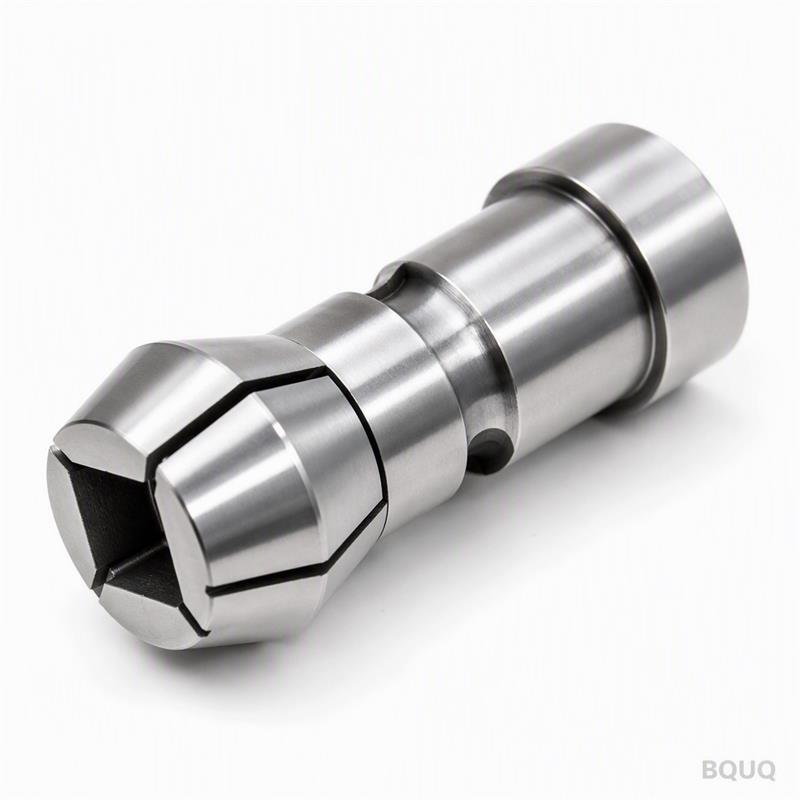
Un mandrin à pince 2J est le dispositif de serrage standard pour les tours suisses et automatiques : un corps de mandrin qui se monte sur la broche, accepte toute la gamme de pinces 2J, et les ouvre et les ferme via le tube de tirage de la machine. Il mérite son étiquette de cheval de trait car un seul corps de mandrin, associé à une étagère de pinces 2J, couvre une large plage de barres avec des changements rapides et une concentricité répétable.
Demandez à n'importe quel atelier utilisant des tours suisses ou automatiques à cames ce qui maintient la barre, et la réponse est généralement la même : un système 2J. La gamme de pinces est compacte, les corps de mandrin sont éprouvés, et l'économie est simple — vous achetez le mandrin une fois, puis n'achetez que les petites pinces bon marché pour chaque nouvelle taille de barre. Ce guide couvre ce qu'est un mandrin 2J, ce qu'il faut vérifier lors de l'achat ou de la spécification, et comment il se comporte sur la machine.
Ce que contient un mandrin à pince 2J
Un mandrin à pince 2J est un corps en acier usiné avec trois fonctions : se monter sur la broche de la machine, positionner la pince de manière concentrique, et transmettre la force du tube de tirage au cône de fermeture de la pince. L'anatomie typique comprend un dos à bride ou fileté correspondant au nez de broche, un alésage et un cône de précision qui positionnent la pince, et un écrou ou un capuchon qui maintient la pince en place pendant que le tube de tirage la tire dans le cône pour la serrage.
Parce que le corps du mandrin est la référence de précision pour tout ce qui suit, sa qualité d'usinage fixe la limite supérieure de votre faux-rond. Un mandrin dont le siège de pince est excentré ou dont le cône est hors de rond transmettra cette erreur à chaque pièce serrée, quelle que soit la qualité de la pince. C'est pourquoi le siège et le cône doivent être rectifiés ou usinés sur des équipements CNC avec vérification, et non pas à l'œil — BQUQ usine ses mandrins à pince suisses de type 2J sur des centres de tournage CNC et maintient les surfaces de positionnement à une classe de 0,005 mm avant même que les pinces ne soient montées.
Capacité et couverture
La gamme 2J couvre les barres rondes de petits diamètres jusqu'à environ 38 mm en haut de la plage, avec des alésages en pouces par pas de 1/64 po et des alésages métriques couramment par pas de 0,5 mm. Les barres hexagonales et carrées réduisent la capacité utile, et les matériaux à paroi mince ou souples peuvent nécessiter un alésage dédié à la taille exacte plutôt qu'un alésage de taille proche. Un plan de couverture réaliste ressemble à ceci :
| Forme de la barre | Taille max typique en 2J | Stratégie d'alésage |
|---|---|---|
| Ronde, tournage général | ~38 mm (1-1/2 po) | Commander un alésage de 0,03 à 0,08 mm au-dessus de la barre, confirmer l'ajustement |
| Hexagonale | ~70–80 % du max rond | Correspondre sur les plats, vérifier le jeu aux angles |
| Carrée | ~60–70 % du max rond | Correspondre sur les plats, surveiller le marquage des arêtes |
| Tube souple ou à paroi mince | Sous le max du système | Alésage à taille exacte, réduction de l'écrasement |
Le schéma est le point clé : la capacité n'est pas un nombre unique, c'est une fonction de la forme et du matériau. Une pince 2J serre sur une petite plage — typiquement quelques centièmes de millimètre d'écrasement — elle doit donc être commandée au diamètre réel de la barre, et non à un diamètre nominal. Lorsque la barre varie plus que ce que la pince peut absorber, vous le voyez comme une perte de serrage ou des pièces hors de rond, et non comme un défaut de la pince.
Comment un mandrin 2J se comporte sur la machine
Deux comportements définissent le mandrin 2J en fonctionnement. Premièrement, c'est un système à alésage traversant : la barre passe à travers le mandrin et la broche, ce qui est exactement ce dont une machine suisse à tête mobile a besoin pour l'avance. Deuxièmement, son comportement axial dépend de la conception de la pince et du mandrin — la différence entre l'action à longueur fixe et l'action de rappel, entièrement couverte dans notre comparaison des pinces à longueur fixe vs pinces à rappel.
En termes simples : une action de rappel tire la barre axialement vers la broche lorsque la pince se ferme, ce qui est acceptable lorsque les pièces sont coupées contre une butée ou que le contrôle de la longueur est souple ; une action à longueur fixe ferme la pince sans déplacer la barre axialement, ce qui est important lorsque vous avancez la barre et coupez à longueur de manière répétée. Pour le travail suisse, où la longueur de chaque pièce dépend du maintien de la barre lorsque la pince se resserre, le comportement à longueur fixe est généralement le bon choix. Demandez à votre fournisseur de mandrins quelle action leur corps produit avant de vous engager, et non après avoir mesuré la dérive sur le premier lot.
Le tableau ci-dessous résume les différences opérationnelles que vous ressentirez réellement sur le terrain :
| Comportement | Ce qui se passe à la fermeture | Mieux adapté à | Attention à |
|---|---|---|---|
| Rappel | La pince tire la barre vers la broche | Pièces dressées contre une butée | Dérive de longueur lors du resserrage |
| Longueur fixe | La pince se referme sur place | Travail suisse et automatique avec avance de barre | Nécessite un siège précis |
| Cône standard | Pince tirée dans le cône du mandrin | Tournage général | Le faux-rond dépend de la propreté du cône |
Achat et montage d'un mandrin 2J
Lorsque vous spécifiez un mandrin 2J, vérifiez cinq choses. Le montage sur broche doit correspondre à votre machine — bride ou filetage, et la bonne taille de nez. L'alésage traversant doit dégager votre plus grande barre plus un peu pour les copeaux. Le siège de pince doit être concentrique et le cône de fermeture propre et sans marques. L'actionnement doit convenir à la force et à la course de votre tube de tirage. Et les pinces doivent être stockées dans les alésages que vous utilisez réellement — il est inutile de posséder un mandrin de précision avec trois pinces mal assorties.
L'installation est simple mais exigeante : nettoyez le nez de broche et la face de montage du mandrin, serrez les fixations de manière uniforme, et contrôlez le siège du mandrin ou une pince d'essai avec un comparateur. Notre guide d'installation des mandrins à pince donne la procédure complète de couple et de mise en place. Si vous partez de zéro sur une ligne suisse ou automatique, l'équipe d'ingénierie BQUQ peut assortir les mandrins et les pinces pour tours automatiques à votre liste de barres — envoyez les tailles de barres et les détails de broche à sc@bquq.com et recevez un devis sous 12 heures ouvrables.
Questions fréquemment posées
Q : Quelles tailles de barres un mandrin à pince 2J peut-il maintenir ?
R : Le mandrin maintient toutes les pinces 2J que vous montez, et la gamme couvre les barres rondes de petits diamètres jusqu'à environ 38 mm en haut de la plage. Chaque pince est commandée pour une taille de barre spécifique, donc la couverture dépend des pinces que vous stockez.
Q : Un mandrin à pince 2J est-il à longueur fixe ?
R : Cela dépend de la conception du mandrin et de la pince, pas seulement du nom 2J. Certaines configurations 2J tirent la barre en arrière lors de la fermeture ; les versions à longueur fixe se ferment sans mouvement axial. Le travail d'avance suisse nécessite généralement une action à longueur fixe.
Q : Un seul mandrin 2J peut-il gérer des barres hexagonales et carrées ?
R : Oui, avec les bons alésages de pince. Les alésages hexagonaux et carrés réduisent la capacité utile — typiquement à 60–80 % du maximum rond — et doivent être assortis à la barre sur les plats avec un jeu aux angles vérifié.
Q : Quel faux-rond dois-je attendre d'un système 2J ?
R : Avec un cône propre, une pince correctement assise et une barre droite, un mandrin bien usiné maintient une concentricité de classe 0,005 mm au nez de la pince. Mesurez avec une barre d'essai rectifiée et un comparateur au nez, puis à nouveau à 25–50 mm de distance.
Q : Pourquoi ma pince 2J ne se ferme-t-elle pas complètement sur certaines barres ?
R : Il est probable que l'alésage soit sous-dimensionné pour la barre réelle, ou que le siège du cône soit sale, ou que la course du tube de tirage soit réglée trop courte. Mesurez la barre, nettoyez le cône et vérifiez la course complète de la pince avant de suspecter le mandrin lui-même.
Rédigé par l'équipe d'ingénierie BQUQ. BQUQ est une usine source certifiée ISO9001 à Dongguan, en Chine, exploitant l'usinage CNC, l'emboutissage des métaux, les ressorts sur mesure, les dissipateurs thermiques et les lignes de pinces sous un même toit. Envoyez les dessins à sc@bquq.com ou WhatsApp +86 13713157787 pour un devis sous 12 heures ouvrables. www.bquq.com