Bagues de guidage fixes ou coulissantes sur tours à poupée mobile : support, jeu, usure et ajustement. BQUQ usine des systèmes de bagues suisses à Dongguan.
Bagues de guidage en tournage suisse : fixes ou coulissantes
Une bague de guidage est la pièce qui rend un tour à poupée mobile « suisse » : un manchon de précision qui soutient la barre immédiatement derrière les outils de coupe, afin que le matériau élancé soit usiné avec précision au lieu de fléchir. Les deux architectures — fixe, où la bague reste stationnaire et la barre glisse à travers elle, et coulissante, où la bague se déplace avec la poupée — font un compromis entre la rigidité du support et la flexibilité d'usinage.
Chaque machine suisse en possède une, et presque aucun atelier ne s'accorde sur le type à utiliser. C'est parce que la réponse dépend réellement du travail. Les pièces longues, fines et à finition élevée privilégient le support rigide d'une bague fixe ; les machines nécessitant une longue course de broche principale ou un ébauchage plus lourd utilisent souvent une bague coulissante. Ce guide explique comment chacune fonctionne, ce que disent les chiffres et comment choisir sans deviner.
Ce que fait réellement la bague
Sur un tour conventionnel, le mandrin maintient une pièce courte et rigide, et l'outil coupe près de la prise. Sur un tour à poupée mobile, la poupée glisse, alimentant la barre au-delà de la zone d'outillage, et la pièce peut être très longue par rapport à son diamètre. Sans support à la coupe, la barre se plierait loin de l'outil et la pièce sortirait conique, ovale ou avec des vibrations.
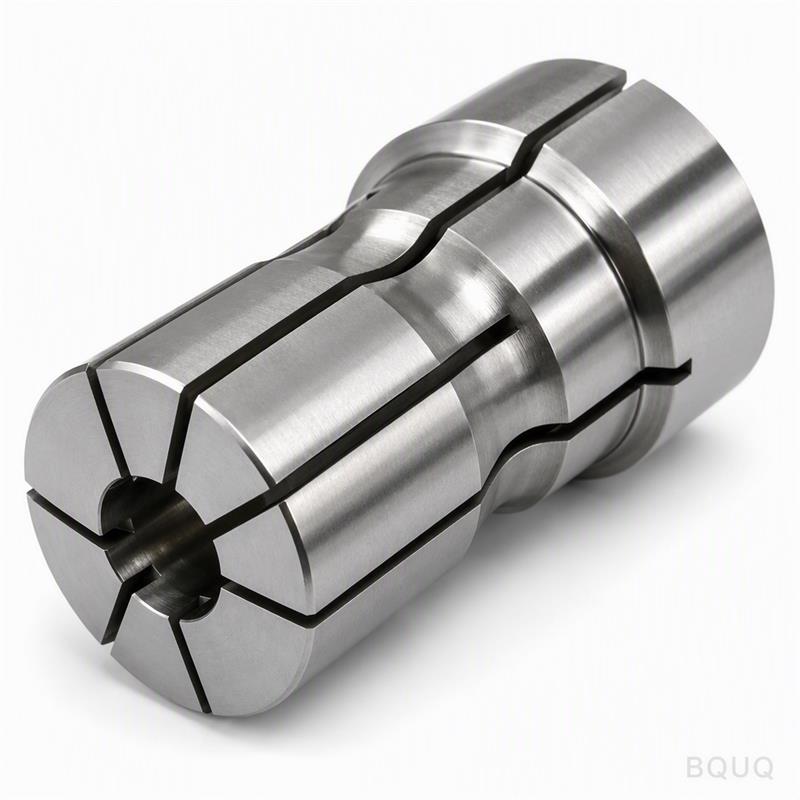
La bague de guidage comble cet écart. Elle est montée juste derrière les outils, son alésage correspond à la barre à quelques millièmes de millimètre près, et elle maintient la barre au point exact où les forces de coupe agissent. La pince de broche alimente et fait tourner la barre ; la bague la positionne. Les deux doivent être corrects — un mandrin à pinces de type suisse qui alimente avec précision et une bague qui soutient avec précision sont les deux moitiés d'un même système.
Fixe ou coulissante : les deux architectures
Dans une machine à bague fixe, la bague est ancrée au bâti de la machine près de la zone d'outillage, et la barre glisse à travers elle pendant que la poupée avance. C'est la configuration suisse classique et la raison pour laquelle le procédé a acquis sa réputation pour les pièces de précision longues et élancées : le point de support ne bouge jamais, donc la barre est guidée au niveau des outils à chaque passe.
Dans une machine à bague coulissante, la bague est portée par la poupée et se déplace avec elle. Le point de support se déplace donc avec la barre, ce qui change ce que la machine peut faire : la broche principale peut usiner sur une course plus longue pendant que la barre reste soutenue, et un ébauchage plus lourd devient pratique car la barre est maintenue plus près de l'endroit où la force est appliquée sur toute la course. Le coût est un ensemble de poupée plus complexe et plus cher, et une bague qui doit être alignée pendant son déplacement.
| Facteur | Bague fixe | Bague coulissante |
|---|---|---|
| Montage | Ancrée au bâti de la machine | Portée par la poupée |
| Point de support pendant l'avance | Stationnaire à la zone d'outillage | Se déplace avec la barre |
| Jeu typique de la barre | Serré, ~0,003–0,008 mm typique | Plus lâche, ~0,01–0,02 mm typique |
| Points forts typiques | Pièces élancées, finition fine, rondeur | Course longue, coupes plus lourdes, flexibilité |
| Points faibles typiques | Usure de la bague à une zone | Plus de pièces à aligner, coût plus élevé |
| Changement | Dimensionner la bague pour chaque barre | Dimensionner la bague et vérifier l'alignement de course |
Les valeurs de jeu sont des plages de fonctionnement typiques pour les barres petites à moyennes, et non des spécifications fixes ; les barres plus grandes et les vitesses plus élevées augmentent les chiffres. La différence architecturale est la partie fiable : fixe signifie un support immobile, coulissante signifie un support qui suit le travail.
Choisir selon la géométrie de la pièce et le procédé
La règle de sélection pratique commence par le rapport longueur/diamètre et la sévérité de la coupe. Si la pièce est longue et élancée — disons plus de 10× le diamètre sans support — vous voulez le point de support aussi près que possible des outils, ce qui indique un fonctionnement à bague fixe. Si le travail est dominé par l'usinage à la broche principale sur une longue course, ou si vous ébauchez agressivement et voulez que la poupée et la bague se déplacent comme une unité rigide, les machines à bague coulissante justifient leur complexité.
Le matériau et la construction de la bague comptent autant que l'architecture. L'alésage de la bague subit l'usure, donc les ateliers de production utilisent des bagues en carbure ou en carbure avec chemises remplaçables pour les longues séries, et de l'acier trempé pour les courtes séries et les matériaux tendres. La bague doit également être dimensionnée en fonction du stock mesuré — un alésage de bague fixe trop serré de 0,005 mm se grippera sur une barre chaude, et un jeu de 0,02 mm laissera la barre fléchir.
| Matériau de la bague | Durée de vie typique | Rôle typique |
|---|---|---|
| Acier à outils trempé | Modérée | Courtes séries, laiton, aluminium, acier doux |
| Carbure de tungstène massif | Longue | Séries à grand volume, alliages abrasifs |
| Carbure avec chemise remplaçable | Longue, renouvellement économique | Production à mélange varié, changements rapides de bague |
| Fendue / ajustable | Dépend du matériau | Ajustement fin du jeu sur travaux de précision |
L'économie est simple : la bague est peu coûteuse par rapport à la barre, à l'outillage et à la broche. Remplacez-la avant qu'elle ne marque le stock ou ne dérive en taille, et gardez des pièces de rechange pour chaque barre que vous utilisez régulièrement.
Faire fonctionner et entretenir chaque type
Quelle que soit l'architecture de votre machine, trois habitudes maintiennent les bagues en bon état. Premièrement, mesurez le diamètre réel de la barre et commandez ou rectifiez l'alésage de la bague en conséquence — les tailles nominales dérivent et les barres aussi. Deuxièmement, gardez la bague et la barre propres et bien lubrifiées ; les copeaux entraînés à travers un alésage serré marquent les deux surfaces en quelques secondes. Troisièmement, surveillez les signes révélateurs : une bande brillante sur la barre, un changement soudain de finition ou des diamètres d'extrémité qui dérivent indiquent tous une usure de la bague avant toute autre chose. Notre guide des systèmes de pinces couvre toute la famille des bagues et la logique de dimensionnement, et l'article sur le faux-rond des pinces explique comment les erreurs de support deviennent des erreurs mesurées sur la pièce.
Lorsque vous spécifiez bagues et pinces ensemble auprès d'une seule source, la responsabilité de l'alignement est plus simple : BQUQ usine le travail de bague de guidage aux côtés de ses mandrins à pinces suisses et pinces de tour automatique avec une capacité CNC de classe 0,005 mm, de sorte que l'alésage, le siège et la conicité sont fabriqués par rapport à la même référence. Envoyez les tailles de stock et les détails de bague à sc@bquq.com pour un devis sous 12 heures ouvrables.
Questions fréquemment posées
Q : Bague fixe ou coulissante — laquelle donne une meilleure finition de surface ?
R : Les bagues fixes gagnent généralement en finition pour les pièces élancées car le point de support ne bouge jamais et le jeu peut être maintenu au plus serré. Les machines à bague coulissante peuvent égaler cela sur les bons travaux mais comportent plus de variables d'alignement. La finition est décidée par le réglage dans les deux cas.
Q : Ai-je besoin d'une bague différente pour chaque taille de barre ?
R : Oui. L'alésage de la bague doit être dimensionné à la barre réelle — généralement de quelques microns à environ 0,02 mm selon le type et le diamètre. Utiliser une bague surdimensionnée pour gagner du temps de changement garantit une flexion et une mauvaise finition.
Q : Pourquoi ma barre a-t-elle une bande brillante à un endroit ?
R : C'est l'usure de contact là où la bague frotte la barre, généralement due à un alésage serré, un fonctionnement à sec ou des copeaux piégés entre la barre et la bague. Arrêtez et vérifiez l'alésage avant que la bande ne devienne une rayure qui marque chaque pièce.
Q : Une machine à bague fixe peut-elle faire le travail d'une bague coulissante ?
R : Pas au sens strict — le montage de la bague est intégré dans l'architecture de la poupée et du bâti. Vous pouvez changer le type de bague (acier, carbure, chemise) et le jeu, mais fixe et coulissante sont des conceptions de machine, pas des options de bague.
Q : À quelle fréquence une bague de guidage doit-elle être remplacée ?
R : Il n'y a pas d'intervalle universel ; cela dépend du matériau, de la vitesse et de la lubrification. Inspectez à chaque changement de travail et remplacez lorsque l'alésage montre un gradin d'usure, lorsque la finition se dégrade ou lorsque les diamètres d'extrémité dérivent — généralement bien avant une défaillance catastrophique de la bague.
Rédigé par l'équipe d'ingénierie BQUQ. BQUQ est une usine source certifiée ISO9001 à Dongguan, en Chine, exploitant l'usinage CNC, l'emboutissage des métaux, les ressorts sur mesure, les dissipateurs thermiques et les lignes de pinces sous un même toit. Envoyez les dessins à sc@bquq.com ou WhatsApp +86 13713157787 pour un devis sous 12 heures ouvrables. www.bquq.com