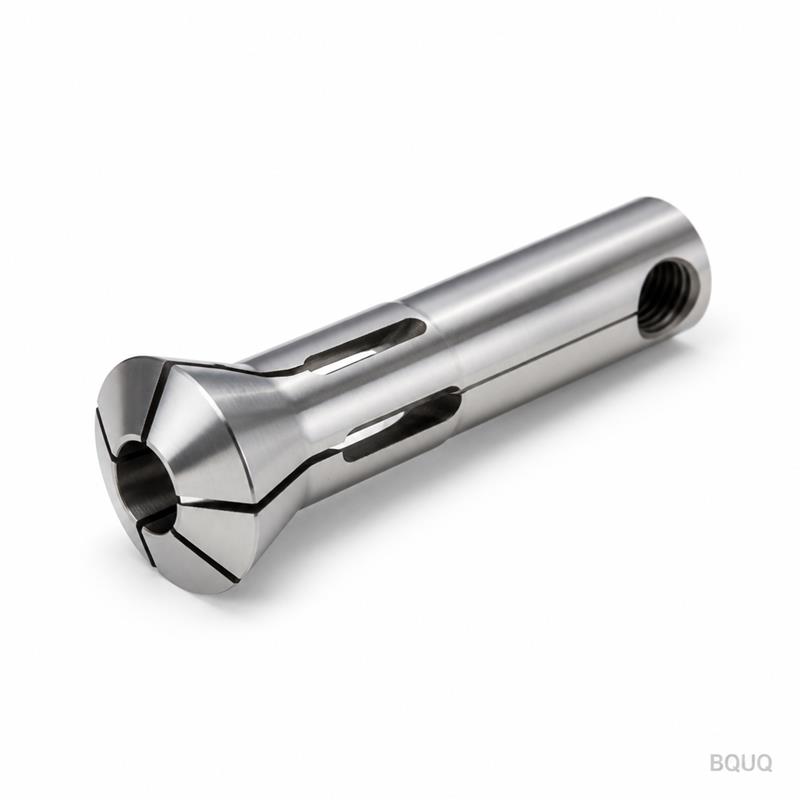
Les pinces de serrage sur mesure résolvent les problèmes de dimensions de barres, de formes et d‘alésages étagés que les modèles standard ne peuvent pas contenir. BQUQ les usine en classe 0,005 mm, ISO9001, devis en 12 h.
Pinces de serrage sur mesure : quand la précision standard ne suffit pas
Commandez une pince de serrage sur mesure lorsque les alésages standard ne peuvent pas faire le travail : barres entre les dimensions du tableau, profils hexagonaux ou triangulaires hors de la gamme standard, alésages étagés pour maintenir une ébauche avec épaulement, barres à paroi mince ou fragiles nécessitant une zone de préhension allégée, ou une géométrie de référence devant correspondre à une machine spécifique. Le dessin qui donne une bonne pince sur mesure spécifie l'interface (famille, cône, filetage), le profil d'alésage, la tolérance de la barre et la classe de faux-rond — dans cet ordre.
Les pinces standard couvrent les barres standard, et les barres standard couvrent la plupart des productions. Mais chaque atelier de tour automatique rencontre un jour le travail que le standard ne peut pas contenir : une dimension métrique entre deux échelons, une barre en pouces dans une machine métrique, un profil polygonal avec des rayons de coin inhabituels, une pièce avec épaulement devant être positionnée axialement, ou une barre souple ou à paroi mince qu'un alésage normal marquerait ou écraserait. C'est le territoire de la pince sur mesure — et c'est de l'ingénierie ordinaire, pas de la magie noire, à condition que la spécification soit complète.
Quand le sur mesure est la bonne décision
Les pinces sur mesure justifient leur coût dans quatre situations. Dimensions de barres inhabituelles : la barre mesure 5,56 mm, ou 7,94 mm hexagonal, et l'alésage standard le plus proche impose une fenêtre de préhension trop grande. Formes de barres inhabituelles : le profil est un polygone avec une géométrie de coin non standard, ou le dessin présente des caractéristiques qu'un profil d'alésage standard ne peut pas reproduire. Besoins de préhension spéciaux : tube à paroi mince, matériau souple ou surface polie devant être maintenue sans marquage, ce qui implique un alésage allégé ou spécialement dégagé. Et les travaux de positionnement : une ébauche avec épaulement devant s'appuyer contre un gradin dans l'alésage pour que chaque pièce démarre à la même position axiale.
| Déclencheur | Résultat avec pince standard | Solution avec pince sur mesure |
|---|---|---|
| Barre entre les dimensions du tableau | Préhension lâche ou inexistante | Alésage usiné à la dimension exacte de la barre |
| Barre en pouces dans une famille métrique | Mauvais alésage, perte de jeu | Alésage usiné à la dimension exacte en pouces |
| Polygone avec rayon de coin inhabituel | Les coins se bloquent ou flottent | Profil correspondant au dessin de la barre |
| Ébauches avec épaulement | Pas de positionnement axial | Alésage étagé positionnant l'épaulement |
| Barre à paroi mince ou souple | Marque ou déforme la pièce | Zone de préhension allégée, fermeture ajustée |
Le schéma : lorsque l'inadéquation vient de l'alésage, le sur mesure gagne. Lorsque l'inadéquation vient de l'interface — mauvaise famille, mauvais cône, mauvais filetage — ce n'est pas un problème de pince sur mesure, c'est un problème de commande erronée ; corrigez d'abord le choix de la famille (notre guide des pinces pour tour automatique couvre la logique des familles).
Le dessin : l'interface d'abord
Un dessin de pince sur mesure commence par l'interface, car l'interface n'est pas négociable. Indiquez la famille de pince (36, 46, 52, 60, 630, 643 ou le code de type spécifique), la marque et le modèle de la machine, et la référence du mandrin ou du tube de tirage. Si la machine est peu connue, un dessin du nez de mandrin et du filetage vaut mieux qu'un long paragraphe de description.
Définissez ensuite la géométrie que l'usine doit reproduire : diamètre du corps, longueur hors tout, angle du cône d'assise et sa profondeur, et le filetage de tirage — ou référez-vous simplement à la famille standard et notez « interface selon la norme de la famille, alésage sur mesure ». Un bon fournisseur confirmera l'interface par rapport à votre référence machine avant de soumissionner, car un alésage sur mesure usiné dans une mauvaise interface est de la ferraille pour vous deux.
| Élément du dessin | Ce qu'il évite |
|---|---|
| Marque/modèle de machine + code famille | Mauvais corps, cône ou filetage |
| Référence mandrin/tube de tirage | Mauvaise profondeur d'assise |
| Profil d'alésage avec dimensions | Mauvaise forme ou taille |
| Matériau et dureté de la barre | Mauvais jeu, marquage |
| Classe de tolérance de la barre | Inadéquation de la fenêtre de préhension |
| Classe de faux-rond requise | Mauvaise qualité pour le travail |
Le profil d'alésage : forme, taille, jeu
La section de l'alésage du dessin est là où vit le travail sur mesure. Montrez le profil en coupe avec les dimensions de contrôle : diamètre pour le rond, sur-plats pour les profils hexagonaux, carrés et triangulaires, plus les rayons de coin là où la barre en a. Ajoutez la vue axiale si l'alésage est étagé ou allégé — un alésage de positionnement d'épaulement nécessite la position du gradin et l'angle de l'épaulement.
Spécifiez explicitement le jeu de travail ou indiquez la tolérance de la barre pour que l'usine puisse le régler. En règle générale, l'alésage est usiné au nominal de la barre avec un petit jeu de travail — typiquement quelques centièmes de millimètre — afin que la barre s'alimente librement mais que les mors se ferment avant leur butée. Si la barre est à l'extrémité supérieure de sa tolérance, dites-le ; l'usine peut élargir la fenêtre d'alésage ou recommander un changement de qualité de barre.
L'allègement est le détail que la plupart des dessins oublient. Un alésage allégé derrière la zone de préhension (l'alésage légèrement ouvert sur une partie de sa longueur) modifie l'endroit où les mors contactent la barre. Pour un tube à paroi mince, un alésage allégé répartit la préhension et évite l'écrasement ; pour les ébauches avec épaulement, un gradin sur toute la profondeur positionne la pièce ; pour une barre polie, une section centrale allégée réduit le marquage. Rien de tout cela n'est standard, ce qui est précisément la raison pour laquelle cela doit figurer sur un dessin sur mesure.
Matériaux et traitement thermique pour le travail sur mesure
Les pinces sur mesure ne sont pas exemptées des règles matériaux — elles les suivent plus scrupuleusement car la géométrie est inhabituelle. Les corps de pinces à ressort nécessitent le même acier trempé ressort et la même conception de fentes résistante à la fatigue que les pinces standard ; la pièce sur mesure ne peut pas sauter le traitement thermique parce qu'elle est unique. Acier allié durci et acier à ressort, trempé et revenu, avec alésage rectifié après traitement, est la base de toute pince sur mesure qui doit serrer et relâcher pendant des milliers de cycles.
Indiquez le service dans la demande : cadence de cycle, matériau de la barre, et si la pince doit survivre à un nombre de pièces spécifique. Une pince sur mesure pour une courte série de prototypage peut utiliser un traitement standard ; une pince sur mesure pour un travail de production qui fabriquera un million de pièces nécessite la conception de fatigue et le certificat de dureté d'un outil de production. Notre article sur les matériaux et traitements thermiques des pinces explique les compromis ; pour le travail sur mesure, mettez le service par écrit afin que l'usine traite la pièce unique comme l'outil de production qu'elle est.
Tolérances et inspection
Les pinces sur mesure sont soumises aux mêmes classes que les pinces standard — plus strictes là où l'application l'exige. Le dessin doit indiquer la classe de faux-rond requise (par exemple, concentricité alésage-cône de classe 0,005 mm), la tolérance d'alésage, et si la pièce est vérifiée pièce par pièce ou par lot. Une pince sur mesure commandée sans classe de faux-rond sera fabriquée selon la valeur par défaut de l'usine, qui peut ou non être suffisante pour la pièce qu'elle maintient.
Attendez-vous à ce que l'usine inspecte la pince sur mesure comme elle inspecte sa gamme standard : contrôle de dureté, géométrie de l'alésage et du cône, faux-rond sur un maître, vérification des fentes. Si un fournisseur traite le sur mesure comme une raison de sauter l'inspection, la pince sur mesure échouera exactement là où elle était censée être meilleure que le standard.
Délais et question du prototype
Les pinces sur mesure prennent plus de temps que les articles standard car l'ébauche doit être usinée, traitée thermiquement et rectifiée selon votre profil plutôt que d'être prise sur une étagère de produits finis. Planification réaliste : l'usine a besoin de quelques jours ouvrables pour un alésage sur mesure simple dans une famille standard, et plus pour un nouveau profil ou un matériau inhabituel. Demandez le délai dans le devis et planifiez le calendrier de production en conséquence.
Pour une géométrie sur mesure à haut risque, l'assurance bon marché est un échantillon ou un contrôle de première pièce avant de s'engager sur un lot. Un profil hexagonal sur mesure avec des rayons de coin inhabituels, ou un alésage étagé positionnant un épaulement critique, mérite un cycle de vérification. BQUQ soumissionne les pinces sur mesure à partir du dessin en 12 heures ouvrables et les usine sur la même ligne CNC que notre gamme standard — acier allié durci et acier à ressort, alésages rectifiés en classe 0,005 mm, données d'inspection avec le lot, le tout sous contrôle ISO9001. Commencez par la gamme de pinces pour tour automatique pour fixer la famille — ou, pour le porte-outil, la gamme de pinces pour mandrins porte-outils — et référez-vous à un exemple réel comme notre pince type 52 à alésage hexagonal, et si la forme de votre barre sort de la gamme standard, le guide des alésages ronds, hexagonaux et triangulaires couvre les règles de dimensionnement que l'usine appliquera. Envoyez le dessin à sc@bquq.com ou WhatsApp +86 13713157787.
Questions fréquemment posées
Q : Quand dois-je commander une pince sur mesure plutôt qu'une pince standard ?
R : Lorsque l'alésage ne peut pas correspondre à votre barre — dimensions inhabituelles, profils polygonaux hors gamme, alésages étagés ou allégés pour ébauches avec épaulement ou fragiles. Si le problème vient de l'interface machine plutôt que de l'alésage, corrigez le choix de la famille au lieu de commander du sur mesure.
Q : Que doit contenir un dessin de pince sur mesure ?
R : L'interface (machine, famille, cône, filetage), le profil d'alésage avec les dimensions de contrôle et les rayons de coin, le matériau et la tolérance de la barre, et la classe de faux-rond. Un dessin complet obtient un devis précis ; un dessin partiel obtient des hypothèses.
Q : Combien coûte en plus une pince sur mesure ?
R : Généralement une prime modeste par rapport à l'équivalent standard — l'ébauche, le traitement et la rectification sont les mêmes ; la différence réside dans l'ingénierie et un profil d'alésage non standard. Le coût est faible par rapport aux rebuts qu'une pince standard inadaptée produirait.
Q : Peut-on fabriquer une pince sur mesure pour une série de prototypage ?
R : Oui. Indiquez le service dans la demande : une pince de prototypage peut utiliser un traitement et des tolérances standard, tandis qu'une pince sur mesure de production nécessite une conception résistante à la fatigue, un traitement thermique complet et une inspection pièce par pièce. L'usine doit traiter les deux comme de véritables outils.
Q : Quel délai dois-je prévoir pour une pince sur mesure ?
R : Un alésage sur mesure simple dans une famille standard ne prend que quelques jours ouvrables de plus qu'un article standard ; un nouveau profil ou un matériau inhabituel prend plus de temps. Demandez le délai dans le devis — BQUQ le confirme lors de la soumission à partir de votre dessin en 12 heures ouvrables.
Rédigé par l'équipe d'ingénierie BQUQ. BQUQ est une usine source certifiée ISO9001 à Dongguan, en Chine, exploitant des lignes d'usinage CNC, d'emboutissage des métaux, de ressorts sur mesure, de dissipateurs thermiques et de pinces sous un même toit. Envoyez les dessins à sc@bquq.com ou WhatsApp +86 13713157787 pour un devis en 12 heures ouvrables. www.bquq.com